
Designing a Model-Agnostic LLM Application: A Practical Architecture
As AI applications evolve, depending too heavily on a single model integration can become a maintenance problem.
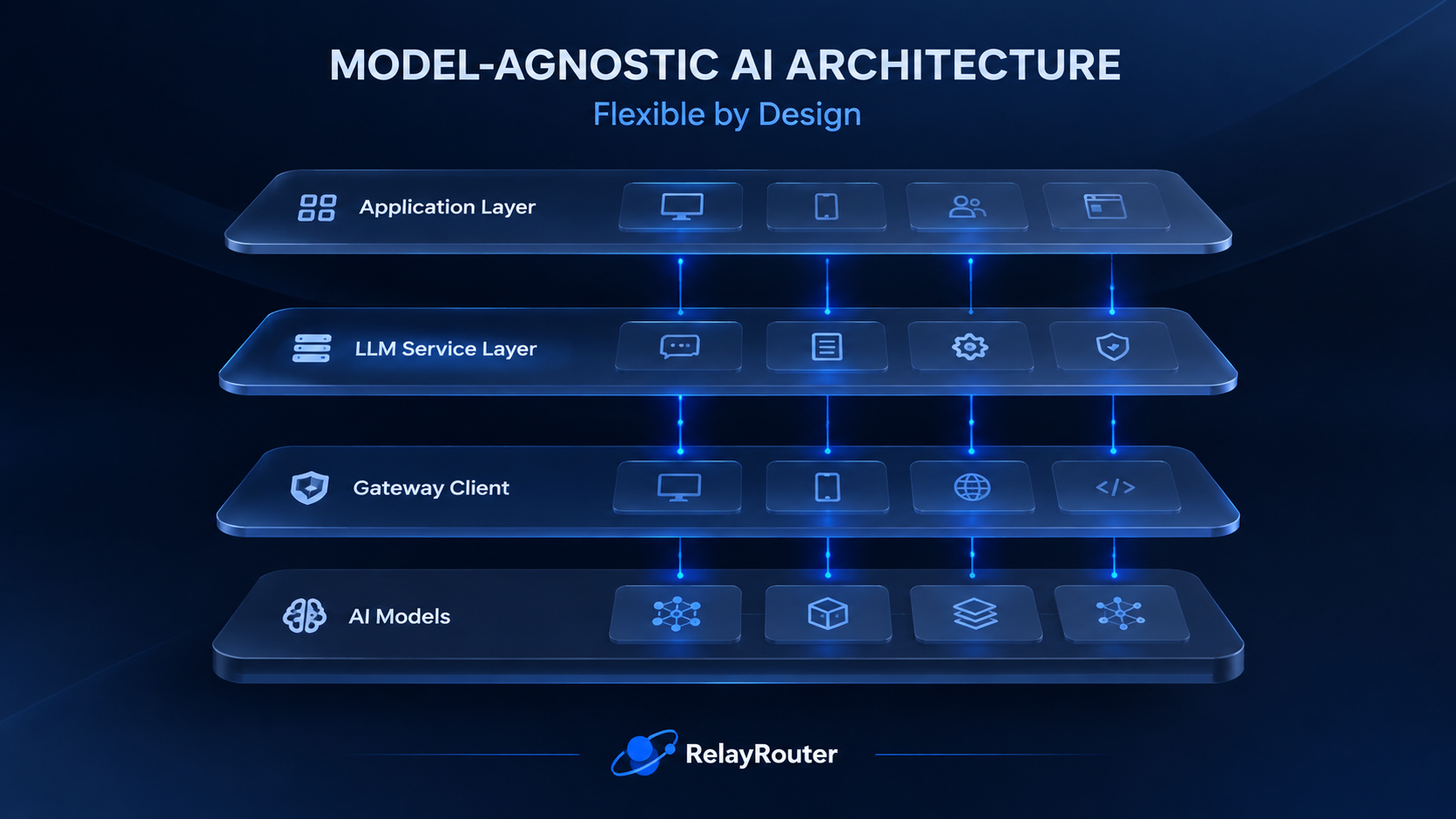
The goal of a model-agnostic architecture is not to pretend that every model behaves identically. Instead, it is to isolate provider-specific complexity and make model selection an explicit engineering decision.
Let's examine a practical design.
1. The Problem with Tight Coupling
A tightly coupled application may combine model identifiers, request configuration, business prompts, and response handling in the same function.
This works for a small prototype.
However, switching models or introducing additional use cases can require changes across several parts of the application.
A cleaner design separates these responsibilities.
2. A Four-Layer Architecture
Consider the following architecture:
Application Layer
Contains product-specific logic such as customer support, summarization, or document analysis.
↓
LLM Service Layer
Defines reusable operations such as generate_text() and summarize().
↓
Gateway Client Layer
Handles authentication, request formatting, timeouts, model identifiers, and response normalization.
↓
Model Execution Layer
Processes the request using the selected supported model.
A gateway such as RelayRouter can provide a centralized model access point within this design.
3. Model Selection Should Be Configuration
Model names should generally be separated from business logic.
A basic configuration structure might look like this:
MODEL_CONFIG = {
    "summarization": "configured-summary-model",
    "classification": "configured-classifier-model",
    "content_drafting": "configured-writing-model",
}
These identifiers are placeholders, not real model IDs.
Your application can retrieve actual supported identifiers from its configuration.
The important principle is that changing a model should not require rewriting the task's business logic.
4. Capability Differences Still Matter
A unified access layer does not eliminate model differences.
Before routing a task to another model, check:
Supported input and output formats
Context window requirements
Tool-calling compatibility
Structured output behavior
Model-specific request parameters
Usage limits and pricing
A robust abstraction should expose these differences rather than hide them until runtime errors occur.
5. Observability Is Part of the Architecture
A practical production system should record enough information to diagnose problems.
Useful fields include:
Request timestamp and internal correlation ID
Selected model
Request status
Latency
Available token usage
Retry count
Estimated cost based on current pricing
Avoid logging sensitive prompts or responses without appropriate authorization and retention controls.
6. Design for Failure
Applications should explicitly handle authentication errors, rate limits, connection failures, and unsupported capabilities.
Retries need bounds and should use backoff. Fallback models should be tested against the specific task before automatic routing is enabled.
If a tool call changes external state, retrying the complete operation may introduce duplicate side effects.
Reliability comes from deliberate policies, not simply adding more retries.
7. Start Small, Then Measure
You do not need a complicated routing engine to begin.
Start with a central client, configurable model identifiers, consistent error handling, and basic request logging.
Then introduce capabilities such as model evaluation, fallback rules, and cost-aware routing when the data supports them.
Conclusion
A model-agnostic architecture gives engineering teams more control over how their applications evolve.
The most valuable abstraction is one that reduces unnecessary coupling while keeping model capabilities, limitations, and operational costs visible.
For a multi-model integration starting point:
RelayRouter: https://api.relayrouter.ai/register?aff=xc9N
GitHub Quickstart: https://github.com/whale0yep-ai/relayrouter-api-quickstart
This article was developed with AI assistance. The architecture is illustrative; validate endpoints, model capabilities, and code behavior against current documentation before production use.
Tags: #LLM #SoftwareArchitecture #AI #Python